




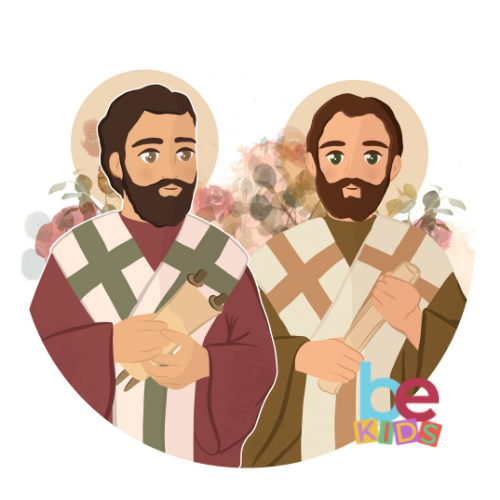
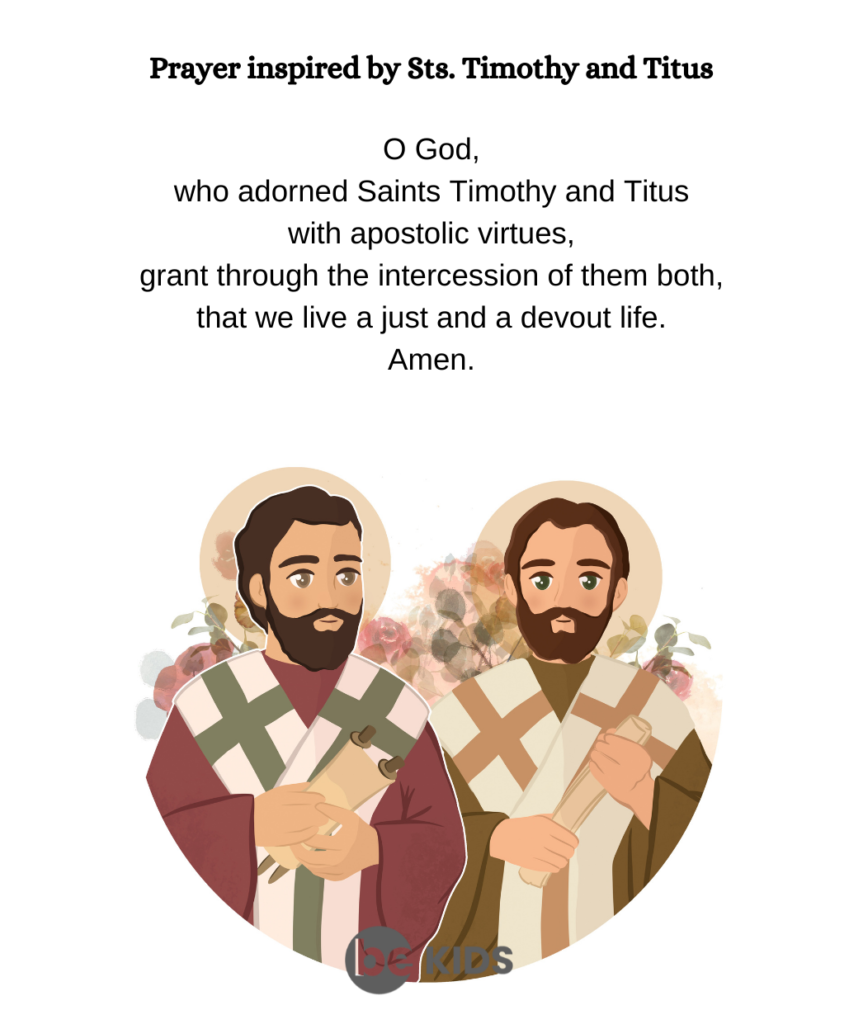
Saints Timothy and Titus celebrate their feast day on the same day (26th January). It is the day following the celebration of the conversion of St. Paul (25th January). References to these saints are found in the Acts of the Apostles and in three letters of St. Paul.
Timothy and Titus found a place in the history of the Early Church and are recorded in the Bible because they were two of the disciples following St. Paul, who after his conversion on the road to Damascus, travelled on missionary journeys to spread the Good News that the Risen Christ is the Son of God.
The spread of Christianity in the Early Church presented many challenges: hardships of travelling, the resolving of conflicts arising from different opinions, beliefs and cultures. Timothy and Titus faced all this together with Paul. Wherever Paul journeyed, he appointed assistants from those who were accompanying him. These then, became priests and bishops together with deacons to assist them, to continue evangelizing what had been started by Paul himself. This led to a local Church to be established. Both Timothy and Titus were called to fulfill these roles.
St. Timothy was born in Lystra, Turkey. His mother Eunice and grandmother Lois were Jewish who had converted to Christianity. His father was a Greek gentile. Timothy grew up to be timid and reserved, believed to have suffered from some form of poor health. Probably, as he was growing up, he was not accepted by neither the Christian nor the Greek communities of Lystra.
When St. Paul came to Lystra on his second missionary journey, Timothy met St. Paul. He later left his house, his parents and his country to follow and accompany St. Paul. During their journeys, together with Silas, they stopped at several places to preach the message of Christianity. He had a close relationship with St. Paul, who refers to him as his “spiritual son” and in a letter to the Philippians, he describes him by stating “I have no one like him.”
In 64 AD, St. Paul ordained Timothy as Bishop of Ephesus to continue establishing the church there. Tradition holds that Timothy was stoned to death when he tried to stop a celebration to the goddess Diana by preaching the Gospel.
St. Titus was Greek, most probably a native of Crete. Tradition holds that he studied Greek philosophy and the ancient poets. It seems that he converted to Christianity when St. Paul visited Crete. Then he became his secretary and interpreter. He accompanied St. Paul on his journeys even when St. Paul travelled to Jerusalem for important meetings with the other Apostles.
St. Titus has been described as a “peacemaker, an administrator and a missionary” while St. Paul described him as “a true child of mine in the faith” and as a “partner and fellow worker. When St. Paul moved on with his missionary journeys, he left Titus in Crete to “set” the Church there “in order”. Eventually Titus became the first Bishop of Crete. Titus was not a martyr, but he lived a long life, and he died a natural death.

This week’s content

About
This new bekids.mt aims to offer an even more comprehensive catechetical formation for children preparing to receive the sacraments.