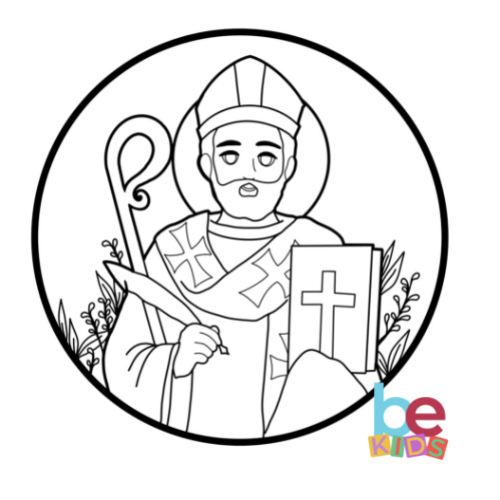





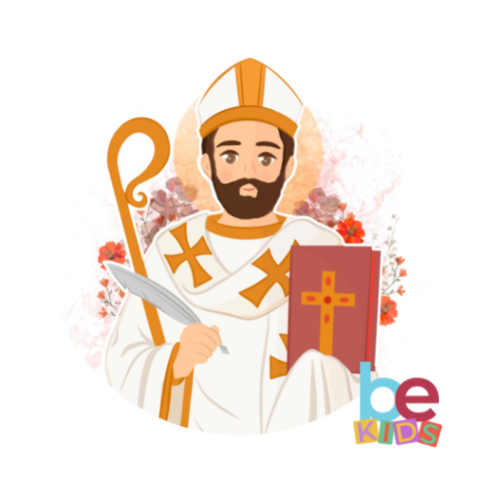
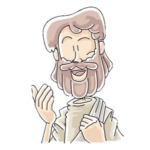
St. John Chrysostom was born in Antioch, Roman Syria, in the year 347.
His father Secundus was an officer of high rank in the Syrian Army. Soon after John’s birth, his father died and Anthusa, John’s mother, dedicated herself to the education of her two children, John and an elder sister. She sent him to the best schools in Antioch, where he studied under Libanius, a most famous pagan orator of those times. John was highly intelligent proving to be a gifted student.
When he was 18 years old, he experienced a spiritual conversion. He was baptized and started a deep study of the Bible. After three years he joined a group of monks and later he moved further in the mountains to live in a cave as a hermit. But this kind of austere life took a toll on his health, and he returned to join the monks once again in Antioch. Soon he became known for his biblical knowledge and his eloquence in speech. He was ordained a priest when he was 39 years old. He continued to speak out in favour of the people who were experiencing unjust treatment or as mediator. In fact, he intervened when the people revolted against the Emperor because of the heavy taxes he had imposed to strengthen his army.
At 51, he was appointed Bishop, Patriarch of Constantinople. As a bishop, he lived a simple life, giving away possessions from the bishop’s residence, so that the proceeds could go for the building of hospitals and other charitable works. He took a strong stance against the rich for not sharing their wealth with the needy, while he appealed strongly to the powerful, attempting to get rid of violence. He set out on a path of reform for the somewhat lax lifestyle of both clergy and the bishops. He spoke out eloquently in favour of charity and social justice.
His appeals irked the authorities, in every sphere of society, including the Empress Eudoxia. Although he had the support of Pope Innocent l, he was still denounced, accused of misconduct, and exiled to Caucasus, Armenia. Later, he was exiled even farther to the farthest boundary of the Empire near the Black Sea.
He died in the year 407 on his way to his final place of exile near the Black Sea, worn down by illness, suffering, and exhaustion. His last words were: “Glory be to God for all things.”
St. John Chrysostom is one of the Greek Fathers who has been declared Doctor of the Church because his ‘writing and preaching stands out as a guide to the faithful during the history of the Church.’ He has been described as “a prophet who comforted the disturbed and disturbed the comfortable”. John was given the title Chrysostom – Golden Mouth, because he was talented as an eloquent preacher.

About
This new bekids.mt aims to offer an even more comprehensive catechetical formation for children preparing to receive the sacraments.