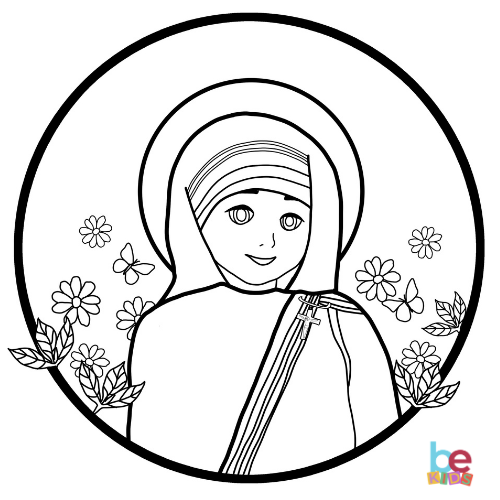





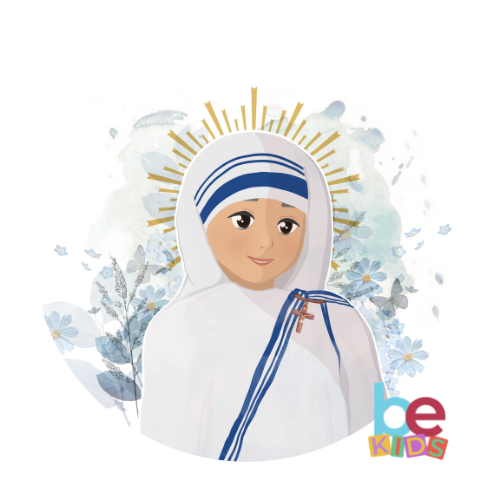
Agnes Gonxha Bojaxhiu was born on 26 August 1910 in Skopje, now part of Macedonia. She became the world-renowned Mother Teresa of Calcutta, the woman small in stature but a great giant in her projection of the love of God.
At the age of eighteen, she decided to join the Congregation of the Missionary Sisters of Our Lady of Loreto. It was on September 10, 1946, while she was on a train traveling to attend the spiritual exercises, that the phrase “I thirst!” kept echoing in her mind. This was the cry of Jesus crucified on the cross. She had to leave the convent to dedicate herself to the poorest of the poor, ensuring they would no longer die without dignity and could instead pass away in eternal peace.
In 1950, the Diocese approved Mother Teresa’s new congregation – the Missionaries of Charity. In total, there are 5000 members in around 600 homes scattered across the world. In addition to the three vows of poverty, chastity, and obedience, every Missionary of Charity takes a further vow: that of free service to the poorest of the poor.
In 1979, Mother Teresa won the Nobel Peace Prize. She was awarded this Prize for her humanitarian efforts to uphold “the poorest of the poor”. She declined the banquet in honour of her Nobel Prize Award and but forwarded the money to the poor in India. She has been described as “the Angel of Mercy” but she described herself as “a pencil in God’s Hands to write His love letter to the world.”
She visited Malta in 1967 and 1976. In 1989, Mother Teresa’s sisters opened a house in Cospicua to carry out their mission among the poorest of the poor.
Mother Teresa died on September 5, 1997, in Calcutta, India. On October 19, 2003, she was beatified by Pope John Paul II. Pope Francis canonised her at a ceremony in September 2016 in St. Peter’s Square in Vatican City.
Mother Teresa was a nun and she helped and served the poor. Even though she knew God loved her, she was experiencing spiritual darkness; however, she remained one with God, her lover, through praying while serving him. In 1979, she won the Nobel Peace Award because “for work undertaken in the struggle to overcome poverty and distress, which also constitutes a threat to peace.”
The 21st of September is the International Day of Peace and to remember and follow Mother Teresa’s steps we are going to create the peace sign poster!

We need:
- Big White Cardboard
- Paint (different colours) + Paint Brush
- Pencil
What to do:
- On the white cardboard, with a pencil draw the peace sign
- Dip the paint brush in some paint and colour the palm of
your hands and your family - Stamp your hand on the sign marked with the pencil
- Use different colours and repeat until you’re ready.
- Look for a nice peaceful quote and neatly, write it down around the peace sign.
- When it dries, hang it to be visible from your house façade.
- Don’t forget to take a photo and send it to us!
This week’s content

About
This new bekids.mt aims to offer an even more comprehensive catechetical formation for children preparing to receive the sacraments.