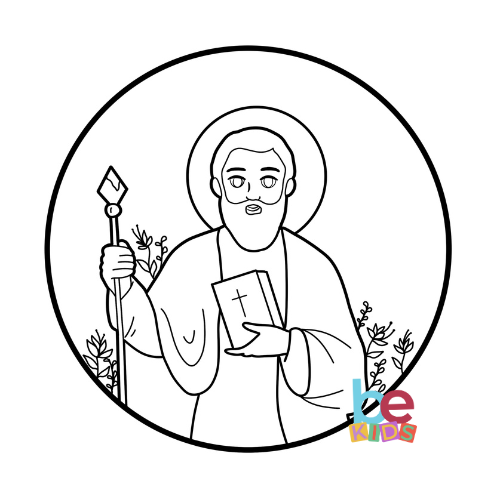





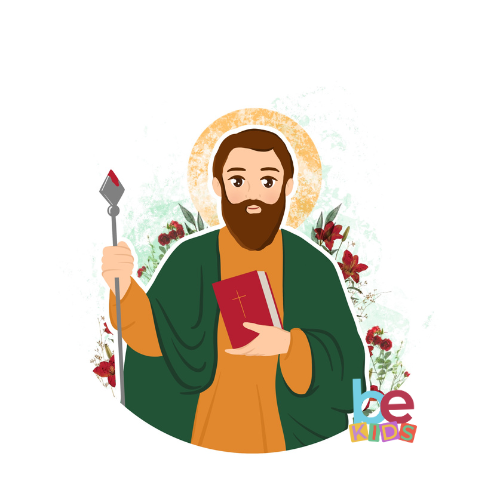
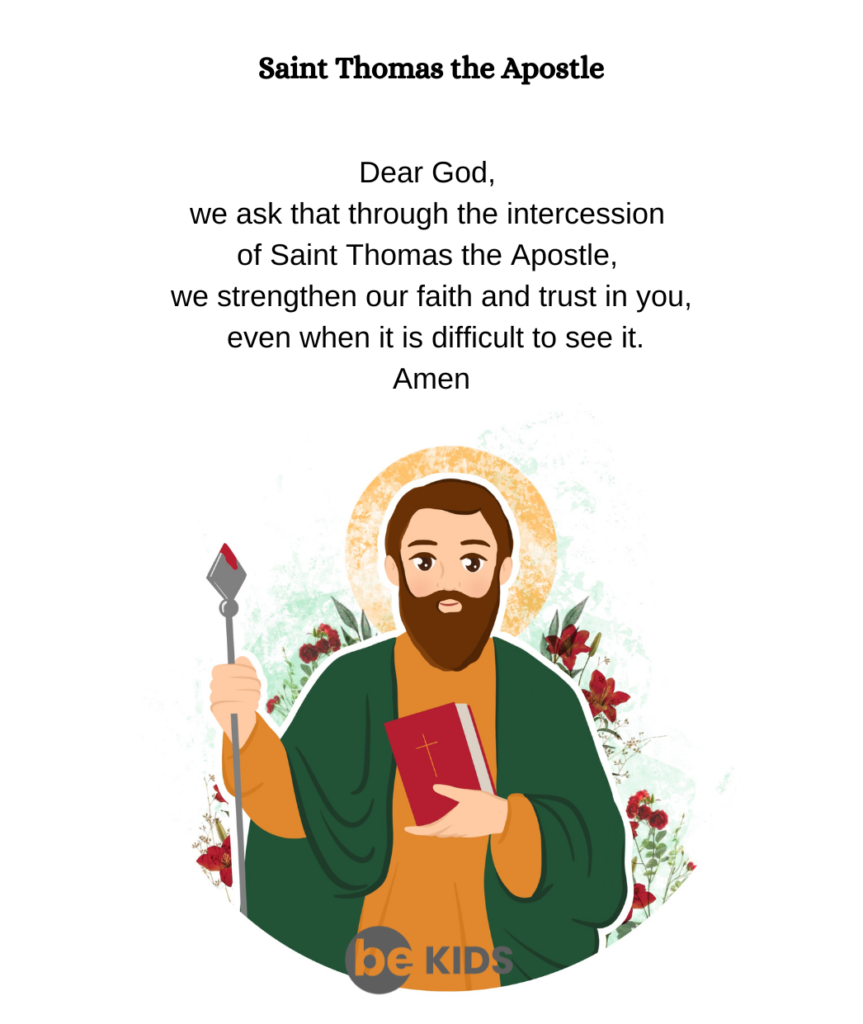
Saint Thomas the Apostle is known as the doubter. His name means “Twin” in Syriac, and “Didymus” in Greek.
We know almost nothing about the life of this Apostle. We do know that he was a Jew and that he grew up in a simple family in one of the villages of Galilee. He was likely a fisherman, and there is no clue as to how he was called to be one of the Twelve. His name is mentioned as one of the Apostles in the Synoptic Gospels (the Gospels according to Matthew, Mark and Luke), while his personality stands out when Thomas is mentioned in the Gospel according to John. In this Gospel, we find words that came from the mouth of Thomas himself in three different situations, more than most of the other Apostles.
Thomas stands out as a faithful Apostle of Jesus (John 11:16). When Jesus was going back to Judea to visit Lazarus, the Apostles were uncertain because if he went back, it could be a threat to Jesus’ life due to the aggression of the authorities. It was Thomas who encouraged the other Apostles to accompany Jesus and if necessary, die with him! It was during the Last Supper (John 14: 1-5) that Thomas, like a curious student, confessed that he did not understand where Jesus was going to prepare a place for them. Thomas received a significant declaration from Jesus himself where he stated that ‘He is the Way, the Truth and the Life’.
After the Resurrection of Jesus, Thomas appears as the Apostle who changed from a doubter to an Apostle who made a great statement in the Divinity of Jesus. (John 20:24-31) Thomas did not want to accept what the other Apostles who had seen the risen Lord told him; he said that he would only believe if he himself saw the marks of the Passion. Jesus gave him this opportunity when he appeared to the Apostles a week later where from the mouth of St. Thomas came the declaration “My Lord and my God,” Jesus continued by saying to him, “You believed because you saw me: blessed are those who have not seen and have believed!”
What we know about St. Thomas after Pentecost is based on Tradition. It is understood that the Apostles agreed on which countries they would go to evangelize. Thomas was sent to spread the Good News in Parthia, Media and Persia and he continued his journey until he reached India, arriving at the Malabar Coast.
Saint Thomas suffered martyrdom, struck by a lance, and was buried in Mylapore, India. Later, his remains were taken to Ortona, Italy.


About
This new bekids.mt aims to offer an even more comprehensive catechetical formation for children preparing to receive the sacraments.